GtoPdb is requesting financial support from commercial users. Please see our sustainability page for more information.

|
Synonyms: FTY-720 | FTY720 | Gilenya®


fingolimod is an approved drug (FDA (2010), EMA (2011))
Compound class:
Synthetic organic
Comment: Fingolimod was the first approved oral therapy for multiple sclerosis.
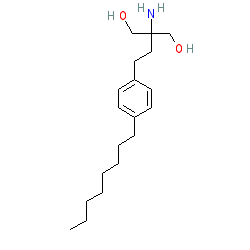
Fingolimod FTY720) is the prodrug of a S1P receptor agonist [4]. When fingolimod binds to S1P1R the complex is internalised and then degraded, so the drug acts as an indirect functional antagonist by preventing intracellular signalling. It acts as a lymphocyte migration inhibitor, promoting lymphocyte retention in lymphoid tissues, whilst preserving lymphocyte function [7]. Clinical efficacy results from modulation of S1P1 receptors. Adverse effects are thought to be caused by fingolimod's off-target effects on other S1P receptor subtypes. Selective S1P1R agonists are being developed and investigated for immunomodulatory/immunosuppresant potential. COVID-19: Fingolimod has been evaluated in a small study of patients with moderate to severe COVID-19 (n=19), with mixed results [10]. Three days of treatment (in addition to standard interventions) did not reduce intubation or mortality rates, compared to placebo controls (n= 21), but it did signficantly reduce the re-admission rate. 
Ligand Activity Visualisation ChartsThese are box plot that provide a unique visualisation, summarising all the activity data for a ligand taken from ChEMBL and GtoPdb across multiple targets and species. Click on a plot to see the median, interquartile range, low and high data points. A value of zero indicates that no data are available. A separate chart is created for each target, and where possible the algorithm tries to merge ChEMBL and GtoPdb targets by matching them on name and UniProt accession, for each available species. However, please note that inconsistency in naming of targets may lead to data for the same target being reported across multiple charts. ✖
View more information in the IUPHAR Pharmacology Education Project: fingolimod |
|
|||||||||||||||||||||||||||||||||||
Classification  |
|
| Compound class | Synthetic organic |
| Approved drug? | Yes. US FDA (2010) | EU EMA (2011) |
| Is prodrug? | Yes |
| Active form | fingolimod-phosphate |
| IUPAC Name |
| 2-amino-2-[2-(4-octylphenyl)ethyl]propane-1,3-diol |
| International Nonproprietary Names |
|
| INN number | INN |
| 8341 | fingolimod |
| Synonyms |
| FTY-720 | FTY720 | Gilenya® |
| Database Links |
|
| Specialist databases | |
| GPCRdb Ligand | fingolimod |
Reactome Drug

|
R-ALL-9678808 |
|
Reactome Reaction
|
R-HSA-9678854 |
| Other databases | |
| BindingDB Ligand | 50158336 |
| CAS Registry No. | 162359-55-9 (source: Scifinder) |
| ChEBI | CHEBI:63115 |
| ChEMBL Ligand | CHEMBL314854 |
| DrugBank Ligand | DB08868 |
| DrugCentral Ligand | 4167 |
| GtoPdb PubChem SID | 135650261 |
| PubChem CID | 107970 |
| Search Google for chemical match using the InChIKey | KKGQTZUTZRNORY-UHFFFAOYSA-N |
| Search Google for chemicals with the same backbone | KKGQTZUTZRNORY |
| Search PubMed clinical trials | fingolimod |
| Search PubMed titles | fingolimod |
| Search PubMed titles/abstracts | fingolimod |
| UniChem Compound Search for chemical match using the InChIKey | KKGQTZUTZRNORY-UHFFFAOYSA-N |
| UniChem Connectivity Search for chemical match using the InChIKey | KKGQTZUTZRNORY-UHFFFAOYSA-N |
| Wikipedia | Fingolimod |
Product supplier links are provided as a service to assist in identifying commercial suppliers of reagents that are mentioned on the IUPHAR/BPS Guide to PHARMACOLOGY database website, and do not imply their endorsement by NC-IUPHAR.
Links are provided in return for sponsorship, used to fund improvements to this database. The sponsorship account is managed and audited by the University of Edinburgh, a charitable body registered in Scotland, SC005336. If you are interested in sponsoring the database, please contact us.
✖

Fingolimod (links to external site)
Cat. No. HY-11063 |