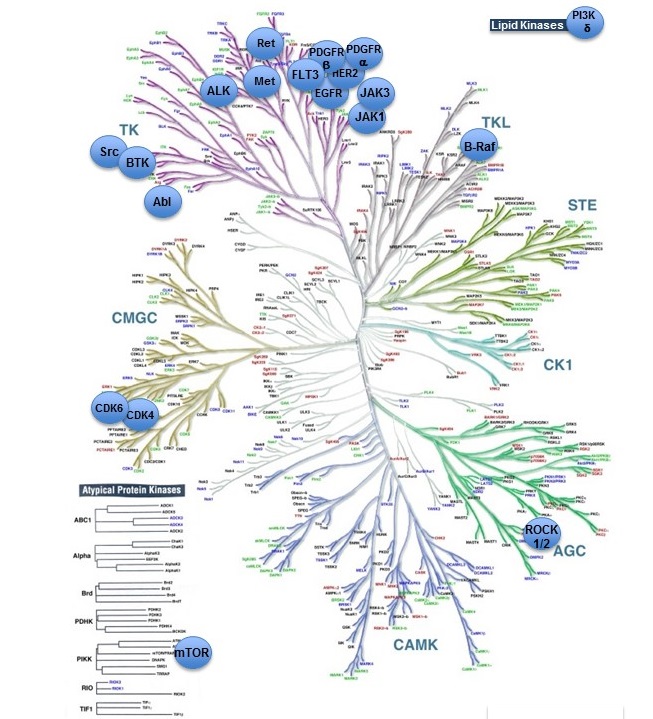
N.B. Further receptors can be found in IUPHAR-DB: Go to site »
Receptor tyrosine kinases (RTKs) are a family of 58 cell-surface receptors [8], which transduce signals to polypeptide and protein hormones, cytokines and growth factors. RTKs are of widespread interest not only through physiological functions, but also as drug targets in many types of cancer and other disease states. A high proportion of drugs exploiting these targets are biological, acting to block the receptor or chelate the cytokine, thereby preventing the biological activity. RTKs are dimeric proteins and most structurally diverse in the extracellular region, but exhibit marked similarities in the hydrophobic transmembrane region and the conserved intracellular protein tyrosine kinase domain, often split into two regions. Binding of agonist evokes autophosphorylation leading to the stimulation of multiple signal transduction pathways, including phospholipase C-γ, mitogen-activated protein kinases and phosphatidylinositol 3-kinase.
ErbB (epidermal growth factor) receptor family
More information on this family may be found on the IUPHAR-DB family and introduction pages.
ErbB family receptors (ENSFM00410000138465) are Class I receptor tyrosine kinases [8]. ErbB2 (also known as HER-2 or NEU, ENSG00000141736) appears to act as an essential partner for the other members of the family without itself being activated by a cognate ligand [9].
Unless otherwise stated all data refer to the human proteins. Gene information is provided for human (Hs), mouse (Mm) and rat (Rn).
|
epidermal growth factor receptor Show »« Hide
|
|||||||||||||||||||||||
|
v-erb-b2 erythroblastic leukemia viral oncogene homolog 3 (avian) Show »« Hide
|
|||||||||||||||||||||||
|
v-erb-a erythroblastic leukemia viral oncogene homolog 4 (avian) Show »« Hide
|
|||||||||||||||||||||||
|
v-erb-b2 erythroblastic leukemia viral oncogene homolog 2, neuro/glioblastoma derived oncogene homolog (avian) Show »« Hide
|
[125I]EGF (human) has been used to label the ErbB1 EGF receptor. The extracellular domain of ErbB2 can be targetted by the antibodies trastuzumab and pertuzumab to inhibit ErbB family action. The intracellular ATP-binding site of the tyrosine kinase domain can be inhibited by GW583340 (7.9–8.0, [6]), gefitinib, erlotinib and tyrphostins AG879 and AG1478.
Ligands of the ErbB family of receptors are peptides including EGF (ENSG00000138798), amphiregulin (also known as colorectal cell-derived growth factor, ENSG00000109321), betacellulin (ENSG00000174808), epigen (ENSG00000182585), epiregulin (ENSG00000124882), heparin-binding EGF-like growth factor (HB-EGF or diphtheria toxin receptor, ENSG00000113070), neuregulins (NRG-1, also known as Neu differentiation factor, acetylcholine receptor-inducing activity, heregulin or glial growth factor, ENSG00000157168; NRG-2, ENSG00000158458; NRG-3, ENSG00000185737 and NRG-4, ENSG00000169752) and transforming growth factor-α (TGFα, ENSG00000163235). These ligands appear to be generated by proteolytic cleavage of cell-surface peptides.
Insulin receptor family
The circulating peptide hormones insulin and the related insulin-like growth factors (IGF) activate Class II receptor tyrosine kinases [8], to evoke cellular responses, mediated through multiple intracellular adaptor proteins. Exceptionally amongst the catalytic receptors, the functional receptor in the insulin receptor family is derived from a single gene product, cleaved post-translationally into two peptides, which then cross-link via disulphide bridges to form a heterotetramer. Intriguingly, the endogenous peptide ligands are formed in a parallel fashion with post-translational processing producing a heterodimer linked by disulphide bridges. Signalling through the receptors is mediated through a rapid autophosphorylation event at intracellular tyrosine residues, followed by recruitment of multiple adaptor proteins, notably IRS1 (ENSG00000169047), IRS2 (ENSG00000185950), Shc1 (ENSG00000160691), Grb2 (ENSG00000177885) and Sos1 (ENSG00000115904).
Unless otherwise stated all data refer to the human proteins. Gene information is provided for human (Hs), mouse (Mm) and rat (Rn).
|
||||||||||||||||||
|
Insulin-like growth factor I Show »« Hide
|
||||||||||||||||||
|
Insulin receptor-related receptor Show »« Hide
|
There is evidence for low potency binding and activation of insulin receptors by IGF1. IGF2 also binds and activates the cation-independent mannose 6-phosphate receptor (CI-MPR, insulin-like growth factor II receptor, 300 kDa mannose 6-phosphate receptor, MPR 300, CD222 antigen ENSG00000197081), which lacks classical signalling capacity and appears to subserve a trafficking role [14]. INSRR, which has a much more discrete localization, being predominant in the kidney [13], currently lacks a cognate ligand or evidence for functional impact.
PQ401 inhibits the insulin-like growth factor receptor [5].
PDGF (platelet-derived growth factor) receptor family
PDGF receptors are Class III RTKs, which function as homo- or heterodimers.
Unless otherwise stated all data refer to the human proteins. Gene information is provided for human (Hs), mouse (Mm) and rat (Rn).
|
Platelet-derived growth factor receptor, alpha polypeptide Show »« Hide
|
|||||||||||||||||||
|
Platelet-derived growth factor receptor, beta polypeptide Show »« Hide
|
|||||||||||||||||||
|
v-kit Hardy-Zuckerman 4 feline sarcoma viral oncogene homolog Show »« Hide
|
|||||||||||||||||||
|
colony stimulating factor 1 receptor Show »« Hide
|
|||||||||||||||||||
|
fms-related tyrosine kinase 3 Show »« Hide
|
Endogenous ligands of PDGF receptors are homo- or heterodimeric: PDGFA (PDGF1, ENSG00000197461), PDGFB (SIS, SSV, ENSG00000100311), VEGFE (fallotein, SCDGF, ENSG00000145431) and PDGFD (IEGF, MSTP036, SCDGF-B, ENSG00000170962) combine as homo- or heterodimers to activate homo- or heterodimeric PDGF receptors. SCF (stem cell factor, KITLG, ENSG00000049130) is a dimeric ligand for KIT. CSF1R may be activated by colony stimulating factor 1 (macrophage-CSF, M-CSF, ENSG00000184371), CSF2 (granulocyte-macrophage CSF, GM-CSF, ENSG00000164400) and G-CSF (ENSG00000108342). FLT3L is the cognate ligand of FLT3 (ENSG00000090554).
5'-fluoroindirubinoxime has been described as a selective FLT3 inhibitor [2].
FGF (fibroblast growth factor) receptor family
Fibroblast growth factor (FGF) family receptors are members of the Ret family (ENSFM00640001103095), which respond to members of the FGF family. Ret (rearranged during transfection, ENSG00000165731, also known as CDHF12, CDHR16, HSCR1, MEN2A, MEN2B, MTC1, PTC, RET51) is a signalling partner for the GDNF family of receptors. FGF receptors function as homo- and heterodimers.
Unless otherwise stated all data refer to the human proteins. Gene information is provided for human (Hs), mouse (Mm) and rat (Rn).
|
fibroblast growth factor receptor 1 Show »« Hide
|
||||||||||||||||
|
fibroblast growth factor receptor 2 Show »« Hide
|
||||||||||||||||
|
fibroblast growth factor receptor 3 Show »« Hide
|
||||||||||||||||
|
fibroblast growth factor receptor 4 Show »« Hide
|
Splice variation of the receptors can influence agonist responses.
FGFRL1 (ENSG00000127418) is a truncated kinase-null analogue. Mutations of Ret (and GDNF) genes may be involved in Hirschsprung's disease, which is characterized by the absence of intramural ganglion cells in the hindgut, often resulting in intestinal obstruction.
At least 22 members of the FGF gene family have been identified in the human genome [11]. Within this group, subfamilies of FGF may be divided into canonical, intracellular and hormone-like FGFs. FGF1-FGF10 (ENSG00000113578, ENSG00000138685, ENSG00000186895, ENSG00000075388, ENSG00000138675, ENSG00000111241, ENSG00000140285, ENSG00000107831, ENSG00000102678, ENSG00000070193) have been identified to act through FGF receptors, while FGF11-14 appear to signal through intracellular targets. Other family members are less well characterized.
PD173074 has been described to inhibit FGFR1 and FGFR3 [22].
VEGF (vascular endothelial growth factor) receptor family
VEGF receptors (ENSFM00440000236870) are homo- and heterodimeric proteins, which respond to VEGF proteins, some of which undergo proteolysis prior to receptor binding. Splice variants of VEGFR1 and VEGFR2 generate truncated proteins limited to the extracellular domains, capable of homodimerisation and binding VEGF ligands as a soluble, non-signalling entity.
Unless otherwise stated all data refer to the human proteins. Gene information is provided for human (Hs), mouse (Mm) and rat (Rn).
|
fms-related tyrosine kinase 1 Show »« Hide
|
|||||||||||||||||||
|
kinase insert domain receptor (a type III receptor tyrosine kinase) Show »« Hide
|
|||||||||||||||||||
|
fms-related tyrosine kinase 4 Show »« Hide
|
Ligands at VEGF receptors are typically homodimeric: VEGFA (ENSG00000112715, also known as vascular permeability factor), VEGFB (ENSG00000173511, also known as VEGF-related factor or VRF), VEGFC (ENSG00000150630), VEGFD (ENSG00000165197, also known as c-fos induced growth factor, FIGF) or placental growth factor (ENSG00000119630, also known as PlGF). VEGFA is able to activate VEGFR1 homodimers, VEGFR1/2 heterodimers and VEGFR2/3 heterodimers. VEGFB and placental growth factor activate VEGFR1 homodimers, while VEGFC and VEGFD activate VEGFR2/3 heterodimers and VEGFR3 homodimers, and, following proteolysis, VEGFR2 homodimers.
HGF (hepatocyte growth factor) receptor family
HGF receptors regulate maturation of the liver in the embryo, as well as having roles in the adult, for example, in the innate immune system.
Unless otherwise stated all data refer to the human proteins. Gene information is provided for human (Hs), mouse (Mm) and rat (Rn).
|
met proto-oncogene (hepatocyte growth factor receptor) Show »« Hide
|
|||||||||||||||||
|
Macrophage stimulating 1 receptor (c-met-related tyrosine kinase) Show »« Hide
|
Ligands at the HGF receptor family include HGF (ENSG00000019991, also known as hepapoietin A, scatter factor), synthesized as a single gene product, which is post-translationally processed to yield a heterodimer linked by a disulphide bridge. The maturation of HGF is enhanced by a serine protease, HGF activating complex (HGFAC, ENSG00000109758), and inhibited by HGF-inhibitor 1, HAI (SPINT1, ENSG00000166145), a serine protease inhibitor. Macrophage stimulating protein 1 (MST1, ENSG00000173531, also known as hepatocyte growth factor-like) is a related gene.
SU11274 is an inhibitor of the HGF receptor [20], with the possibility of further targets [1].
Neurotrophin receptor family
Various isoforms of neurotrophin receptors exist, including truncated forms of trkB and trkC, which lack catalytic domains. p75, which has homologies with tumour necrosis factor receptors, lacks a tyrosine kinase domain, but can signal via ceramide release and nuclear factor κB (NF-κB) activation. Both trkA and trkB contain two leucine-rich regions and can exist in monomeric or dimeric forms.
Unless otherwise stated all data refer to the human proteins. Gene information is provided for human (Hs), mouse (Mm) and rat (Rn).
|
neurotrophic tyrosine kinase, receptor, type 1 Show »« Hide
|
||||||||||||||||||
|
neurotrophic tyrosine kinase, receptor, type 2 Show »« Hide
|
||||||||||||||||||
|
neurotrophic tyrosine kinase, receptor, type 3 Show »« Hide
|
||||||||||||||||||
|
nerve growth factor receptor Show »« Hide
|
[125I]NGF (human) and [125I]BDNF have been used to label the trkA and trkB receptor, respectively. The selectivity of small molecule peptide mimetics of NGF has not been ascertained [15]. There are, as yet, no selective antagonists, but activation can be blocked using anti-neurotrophin antisera or selective immunoadhesins that sequester neurotrophins [21]. p75 influences the binding of NGF and NT-3 to trkA. The ligand selectivity of p75 appears to be dependent on the cell type; for example, in sympathetic neurones, it binds NT-3 with comparable affinity to trkC [3].
The endogenous ligands of neurotrophin receptors are small proteins (ca. 120 aa) and include nerve growth factor (NGF, ENSG00000134259), neurotrophin (NT) 3 (NT-3, ENSG00000185652), NT-4 (ENSG00000167744) and brain-derived neurotrophic factor (BDNF, ENSG00000176697).
The intracellular tyrosine kinase activity of the trkA receptor can be inhibited by GW441756 (8.7, [24]) and tyrphostin AG879 [17].
Ephrin receptor family
Ephrin receptors (ENSFM00250000000121) have a role in the regulation of neuronal development. Their ligands are membrane-associated proteins, although the relationship between ligands and receptors has been incompletely defined.
Unless otherwise stated all data refer to the human proteins. Gene information is provided for human (Hs), mouse (Mm) and rat (Rn).
|
||||||||||||||
|
||||||||||||||
|
||||||||||||||
|
||||||||||||||
|
||||||||||||||
|
||||||||||||||
|
||||||||||||||
|
||||||||||||||
|
||||||||||||||
|
||||||||||||||
|
||||||||||||||
|
||||||||||||||
|
||||||||||||||
|
Ligands at the ephrin receptors may be divided into two families, ephrin A and ephrin B. Ephrin A are glycosylphosphatidylinositol-linked proteins: EFNA1 (ENSG00000169242, ECKLG, EPLG1, LERK1, TNFAIP4), EFNA2 (ENSG00000099617, ELF-1, EPLG6, LERK6), EFNA3 (ENSG00000143590, Ehk1-L, EPLG3, LERK3), EFNA4 (ENSG00000243364, EPLG4, LERK4) and EFNA5 (ENSG00000184349, AF1, EPLG7, LERK7). Ephrin B (ENSFM00250000002014) are single TM proteins: EFNB1 (ENSG00000090776), EFNB2 (ENSG00000125266) and EFNB3 (ENSG00000108947).
TAM (or AXL) receptor family
Members of this RTK family (ENSFM00500000269872) represented a novel structural motif, when sequenced. The ligands for this family are able to bind to negatively-charged surfaces of apoptotic cells.
Unless otherwise stated all data refer to the human proteins. Gene information is provided for human (Hs), mouse (Mm) and rat (Rn).
|
AXL receptor tyrosine kinase Show »« Hide
|
||||||||||||||||||
|
TYRO3 protein tyrosine kinase Show »« Hide
|
||||||||||||||||||
|
c-mer proto-oncogene tyrosine kinase Show »« Hide
|
Gas6 (ENSG00000183087, also known as growth arrest specific protein 6, AXLLG, AXSF) and protein S (ENSG00000184500) are secreted plasma proteins which undergo vitamin K-dependent post-translational modifications through the generation of carboxyglutamate-rich domains.
Leukocyte tyrosine kinase (LTK) receptor family
The LTK family (ENSFM00500000270379) appear to lack endogenous ligands.
Unless otherwise stated all data refer to the human proteins. Gene information is provided for human (Hs), mouse (Mm) and rat (Rn).
|
Leukocyte receptor tyrosine kinase Show »« Hide
|
||||||||||||||||
|
anaplastic lymphoma receptor tyrosine kinase Show »« Hide
|
||||||||||||||||
|
c-ros oncogene 1, receptor tyrosine kinase Show »« Hide
|
TIE family of angiopoietin receptors
The TIE family (ENSFM00420000140591) were initially associated with formation of blood vessels.
Unless otherwise stated all data refer to the human proteins. Gene information is provided for human (Hs), mouse (Mm) and rat (Rn).
|
tyrosine kinase with immunoglobulin-like and EGF-like domains 1 Show »« Hide
|
||||||||||||||||||
|
TEK tyrosine kinase, endothelial Show »« Hide
|
Endogenous ligands (ENSFM00500000269808) are angiopoietin-1 (ANGPT1, ENSG00000154188), angiopoietin-2 (Ang2, ENSG00000091879), and angiopoietin-4 (ANGPT4 ENSG00000101280). Related sequences include angiopoietin protein-like 1 (ANGPTL1, ENSG00000116194, also known as angiopoietin 3) and ANGPTL7 (ENSG00000171819, AngX, CDT6). angiopoietin-2 appears to act as an endogenous antagonist of angiopoietin-1 function.
DDR (collagen receptor) family
Collagen receptors (ENSFM00260000050411) are structurally-related membrane protein tyrosine kinases activated by collagen. Collagen is probably the most abundant protein in man, with at least 29 families of genes encoding proteins, which undergo splice variation and post-translational processing, and may exist in monomeric or polymeric forms, producing a triple-stranded, twine-like structure.
Unless otherwise stated all data refer to the human proteins. Gene information is provided for human (Hs), mouse (Mm) and rat (Rn).
|
discoidin domain receptor tyrosine kinase 1 Show »« Hide
|
||||||||||||||
|
discoidin domain receptor tyrosine kinase 2 Show »« Hide
|
In man, principal family members include COL1A1 (ENSG00000108821), COL2A1 (ENSG00000139219), COL3A1 (ENSG00000168542) and COL4A1 (ENSG00000187498).
ROR family and other RTKs
Members of the ROR family (ENSFM00510000502747) appear to be activated by ligands complexing with other cell-surface proteins.
Unless otherwise stated all data refer to the human proteins. Gene information is provided for human (Hs), mouse (Mm) and rat (Rn).
|
receptor tyrosine kinase-like orphan receptor 1 Show »« Hide
|
||||||||||||||
|
receptor tyrosine kinase-like orphan receptor 2 Show »« Hide
|
||||||||||||||
|
Muscle, skeletal, receptor tyrosine kinase Show »« Hide
|
||||||||||||||
|
PTK7 protein tyrosine kinase 7 Show »« Hide
|
||||||||||||||
|
receptor-like tyrosine kinase Show »« Hide
|
ROR1 and ROR2 appear to be activated by Wnt-5a (ENSG00000114251) binding to a Frizzled receptor and forming a cell-surface multiprotein complex [10]. agrin (AGRN, ENSG00000188157) forms a complex with LRP4 (ENSG00000134569) to activate MUSK [12]. PTK7 and RYK also appear to interact with the Wnt signalling system [4,19].
Acevedo, VD; Ittmann, M; Spencer, DM. (2009) Paths of FGFR-driven tumorigenesis. Cell Cycle, 8 (4): 580-8. [PMID:19182515]
Acquaviva, J; Wong, R; Charest, A. (2009) The multifaceted roles of the receptor tyrosine kinase ROS in development and cancer. Biochim. Biophys. Acta, 1795 (1): 37-52. [PMID:18778756]
Augustin, HG; Koh, GY; Thurston, G; Alitalo, K. (2009) Control of vascular morphogenesis and homeostasis through the angiopoietin-Tie system. Nat. Rev. Mol. Cell Biol., 10 (3): 165-77. [PMID:19234476]
Avraham, R; Yarden, Y. (2011) Feedback regulation of EGFR signalling: decision making by early and delayed loops. Nat. Rev. Mol. Cell Biol., 12 (2): 104-17. [PMID:21252999]
Banerjee, A; Macdonald, ML; Borgmann-Winter, KE; Hahn, CG. (2010) Neuregulin 1-erbB4 pathway in schizophrenia: From genes to an interactome. Brain Res. Bull., 83 (3-4): 132-9. [PMID:20433909]
Baselga, J; Swain, SM. (2009) Novel anticancer targets: revisiting ERBB2 and discovering ERBB3. Nat. Rev. Cancer, 9 (7): 463-75. [PMID:19536107]
Beekman, R; Touw, IP. (2010) G-CSF and its receptor in myeloid malignancy. Blood, 115 (25): 5131-6. [PMID:20237318]
Buonanno, A. (2010) The neuregulin signaling pathway and schizophrenia: from genes to synapses and neural circuits. Brain Res. Bull., 83 (3-4): 122-31. [PMID:20688137]
da Cunha Santos, G; Shepherd, FA; Tsao, MS. (2011) EGFR mutations and lung cancer. Annu Rev Pathol, 6: 49-69. [PMID:20887192]
De Palma, M; Naldini, L. (2009) Tie2-expressing monocytes (TEMs): novel targets and vehicles of anticancer therapy?. Biochim. Biophys. Acta, 1796 (1): 5-10. [PMID:19362584]
Eck, MJ; Yun, CH. (2010) Structural and mechanistic underpinnings of the differential drug sensitivity of EGFR mutations in non-small cell lung cancer. Biochim. Biophys. Acta, 1804 (3): 559-66. [PMID:20026433]
Feigin, ME; Muthuswamy, SK. (2009) ErbB receptors and cell polarity: new pathways and paradigms for understanding cell migration and invasion. Exp. Cell Res., 315 (4): 707-16. [PMID:19022245]
Ferguson, KM. (2008) Structure-based view of epidermal growth factor receptor regulation. Annu Rev Biophys, 37: 353-73. [PMID:18573086]
Fiske, WH; Threadgill, D; Coffey, RJ. (2009) ERBBs in the gastrointestinal tract: recent progress and new perspectives. Exp. Cell Res., 315 (4): 583-601. [PMID:19041864]
Frank-Raue, K; Rondot, S; Raue, F. (2010) Molecular genetics and phenomics of RET mutations: Impact on prognosis of MTC. Mol. Cell. Endocrinol., 322 (1-2): 2-7. [PMID:20083156]
Fry, WH; Kotelawala, L; Sweeney, C; Carraway, KL. (2009) Mechanisms of ErbB receptor negative regulation and relevance in cancer. Exp. Cell Res., 315 (4): 697-706. [PMID:18706412]
García-Sáinz, JA; Romero-Ávila, MT; Medina, Ldel C. (2010) Dissecting how receptor tyrosine kinases modulate G protein-coupled receptor function. Eur. J. Pharmacol., 648 (1-3): 1-5. [PMID:20828551]
Gerber, DE; Minna, JD. (2010) ALK inhibition for non-small cell lung cancer: from discovery to therapy in record time. Cancer Cell, 18 (6): 548-51. [PMID:21156280]
Giustina, A; Mazziotti, G; Canalis, E. (2008) Growth hormone, insulin-like growth factors, and the skeleton. Endocr. Rev., 29 (5): 535-59. [PMID:18436706]
Gow, DJ; Sester, DP; Hume, DA. (2010) CSF-1, IGF-1, and the control of postnatal growth and development. J. Leukoc. Biol., 88 (3): 475-81. [PMID:20519640]
Grassot, J; Mouchiroud, G; Perrière, G. (2003) RTKdb: database of Receptor Tyrosine Kinase. Nucleic Acids Res., 31 (1): 353-8. [PMID:12520021]
Green, JL; Kuntz, SG; Sternberg, PW. (2008) Ror receptor tyrosine kinases: orphans no more. Trends Cell Biol., 18 (11): 536-44. [PMID:18848778]
Harada, D; Yamanaka, Y; Ueda, K; Tanaka, H; Seino, Y. (2009) FGFR3-related dwarfism and cell signaling. J. Bone Miner. Metab., 27 (1): 9-15. [PMID:19066716]
Hato, T; Tabata, M; Oike, Y. (2008) The role of angiopoietin-like proteins in angiogenesis and metabolism. Trends Cardiovasc. Med., 18 (1): 6-14. [PMID:18206803]
Holt, RI; Sönksen, PH. (2008) Growth hormone, IGF-I and insulin and their abuse in sport. Br. J. Pharmacol., 154 (3): 542-56. [PMID:18376417]
Hu, Y; Bouloux, PM. (2010) Novel insights in FGFR1 regulation: lessons from Kallmann syndrome. Trends Endocrinol. Metab., 21 (6): 385-93. [PMID:20117945]
Huang, H; Bhat, A; Woodnutt, G; Lappe, R. (2010) Targeting the ANGPT-TIE2 pathway in malignancy. Nat. Rev. Cancer, 10 (8): 575-85. [PMID:20651738]
Itoh, N; Ornitz, DM. (2011) Fibroblast growth factors: from molecular evolution to roles in development, metabolism and disease. J. Biochem., 149 (2): 121-30. [PMID:20940169]
Jaaro-Peled, H; Hayashi-Takagi, A; Seshadri, S; Kamiya, A; Brandon, NJ; Sawa, A. (2009) Neurodevelopmental mechanisms of schizophrenia: understanding disturbed postnatal brain maturation through neuregulin-1-ErbB4 and DISC1. Trends Neurosci., 32 (9): 485-95. [PMID:19712980]
Kadomatsu, T; Tabata, M; Oike, Y. (2011) Angiopoietin-like proteins: emerging targets for treatment of obesity and related metabolic diseases. FEBS J., 278 (4): 559-64. [PMID:21182596]
Kalkman, HO. (2009) Altered growth factor signaling pathways as the basis of aberrant stem cell maturation in schizophrenia. Pharmacol. Ther., 121 (1): 115-22. [PMID:19046988]
Karam, CS; Ballon, JS; Bivens, NM; Freyberg, Z; Girgis, RR; Lizardi-Ortiz, JE; Markx, S; Lieberman, JA; Javitch, JA. (2010) Signaling pathways in schizophrenia: emerging targets and therapeutic strategies. Trends Pharmacol. Sci., 31 (8): 381-90. [PMID:20579747]
Klein, R. (2009) Bidirectional modulation of synaptic functions by Eph/ephrin signaling. Nat. Neurosci., 12 (1): 15-20. [PMID:19029886]
Kleinberg, DL; Wood, TL; Furth, PA; Lee, AV. (2009) Growth hormone and insulin-like growth factor-I in the transition from normal mammary development to preneoplastic mammary lesions. Endocr. Rev., 30 (1): 51-74. [PMID:19075184]
Knights, V; Cook, SJ. (2010) De-regulated FGF receptors as therapeutic targets in cancer. Pharmacol. Ther., 125 (1): 105-17. [PMID:19874848]
Koch, S; Tugues, S; Li, X; Gualandi, L; Claesson-Welsh, L. (2011) Signal transduction by vascular endothelial growth factor receptors. Biochem. J., 437 (2): 169-83. [PMID:21711246]
Kosaka, N; Sakamoto, H; Terada, M; Ochiya, T. (2009) Pleiotropic function of FGF-4: its role in development and stem cells. Dev. Dyn., 238 (2): 265-76. [PMID:18792115]
Laron, Z. (2008) Insulin--a growth hormone. Arch. Physiol. Biochem., 114 (1): 11-6. [PMID:18465354]
Lemke, G; Rothlin, CV. (2008) Immunobiology of the TAM receptors. Nat. Rev. Immunol., 8 (5): 327-36. [PMID:18421305]
Lemmon, MA; Schlessinger, J. (2010) Cell signaling by receptor tyrosine kinases. Cell, 141 (7): 1117-34. [PMID:20602996]
Lichtenstein, L; Kersten, S. (2010) Modulation of plasma TG lipolysis by Angiopoietin-like proteins and GPIHBP1. Biochim. Biophys. Acta, 1801 (4): 415-20. [PMID:20056168]
Lin, SX; Chen, J; Mazumdar, M; Poirier, D; Wang, C; Azzi, A; Zhou, M. (2010) Molecular therapy of breast cancer: progress and future directions. Nat Rev Endocrinol, 6 (9): 485-93. [PMID:20644568]
Lu, X; Kang, Y. (2010) Epidermal growth factor signalling and bone metastasis. Br. J. Cancer, 102 (3): 457-61. [PMID:20010942]
Masson, K; Rönnstrand, L. (2009) Oncogenic signaling from the hematopoietic growth factor receptors c-Kit and Flt3. Cell. Signal., 21 (12): 1717-26. [PMID:19540337]
Minami, Y; Oishi, I; Endo, M; Nishita, M. (2010) Ror-family receptor tyrosine kinases in noncanonical Wnt signaling: their implications in developmental morphogenesis and human diseases. Dev. Dyn., 239 (1): 1-15. [PMID:19530173]
Morandi, A; Plaza-Menacho, I; Isacke, CM. (2011) RET in breast cancer: functional and therapeutic implications. Trends Mol Med, 17 (3): 149-57. [PMID:21251878]
Nakamura, T; Sakai, K; Nakamura, T; Matsumoto, K. (2011) Hepatocyte growth factor twenty years on: Much more than a growth factor. J. Gastroenterol. Hepatol., 26 Suppl 1: 188-202. [PMID:21199531]
Nishita, M; Enomoto, M; Yamagata, K; Minami, Y. (2010) Cell/tissue-tropic functions of Wnt5a signaling in normal and cancer cells. Trends Cell Biol., 20 (6): 346-54. [PMID:20359892]
Pasquale, EB. (2008) Eph-ephrin bidirectional signaling in physiology and disease. Cell, 133 (1): 38-52. [PMID:18394988]
Pines, G; Köstler, WJ; Yarden, Y. (2010) Oncogenic mutant forms of EGFR: lessons in signal transduction and targets for cancer therapy. FEBS Lett., 584 (12): 2699-706. [PMID:20388509]
Pitulescu, ME; Adams, RH. (2010) Eph/ephrin molecules--a hub for signaling and endocytosis. Genes Dev., 24 (22): 2480-92. [PMID:21078817]
Plant, AL; Bhadriraju, K; Spurlin, TA; Elliott, JT. (2009) Cell response to matrix mechanics: focus on collagen. Biochim. Biophys. Acta, 1793 (5): 893-902. [PMID:19027042]
Pyne, NJ; Pyne, S. (2011) Receptor tyrosine kinase-G-protein-coupled receptor signalling platforms: out of the shadow?. Trends Pharmacol. Sci., 32 (8): 443-50. [PMID:21612832]
Ratushny, V; Astsaturov, I; Burtness, BA; Golemis, EA; Silverman, JS. (2009) Targeting EGFR resistance networks in head and neck cancer. Cell. Signal., 21 (8): 1255-68. [PMID:19258037]
Schneider, MR; Sibilia, M; Erben, RG. (2009) The EGFR network in bone biology and pathology. Trends Endocrinol. Metab., 20 (10): 517-24. [PMID:19819718]
Sharif, A; Prevot, V. (2010) ErbB receptor signaling in astrocytes: a mediator of neuron-glia communication in the mature central nervous system. Neurochem. Int., 57 (4): 344-58. [PMID:20685225]
Shoulders, MD; Raines, RT. (2009) Collagen structure and stability. Annu. Rev. Biochem., 78: 929-58. [PMID:19344236]
Sorkin, A; Goh, LK. (2009) Endocytosis and intracellular trafficking of ErbBs. Exp. Cell Res., 315 (4): 683-96. [PMID:19278030]
Takano, H; Ueda, K; Hasegawa, H; Komuro, I. (2007) G-CSF therapy for acute myocardial infarction. Trends Pharmacol. Sci., 28 (10): 512-7. [PMID:17888521]
Underwood, CK; Coulson, EJ. (2008) The p75 neurotrophin receptor. Int. J. Biochem. Cell Biol., 40 (9): 1664-8. [PMID:17681869]
Velloso, CP. (2008) Regulation of muscle mass by growth hormone and IGF-I. Br. J. Pharmacol., 154 (3): 557-68. [PMID:18500379]
Villegas, SN; Canham, M; Brickman, JM. (2010) FGF signalling as a mediator of lineage transitions--evidence from embryonic stem cell differentiation. J. Cell. Biochem., 110 (1): 10-20. [PMID:20336694]
Wesche, J; Haglund, K; Haugsten, EM. (2011) Fibroblast growth factors and their receptors in cancer. Biochem. J., 437 (2): 199-213. [PMID:21711248]
Wieduwilt, MJ; Moasser, MM. (2008) The epidermal growth factor receptor family: biology driving targeted therapeutics. Cell. Mol. Life Sci., 65 (10): 1566-84. [PMID:18259690]
Wilson, KJ; Gilmore, JL; Foley, J; Lemmon, MA; Riese, DJ. (2009) Functional selectivity of EGF family peptide growth factors: implications for cancer. Pharmacol. Ther., 122 (1): 1-8. [PMID:19135477]
Wu, X; Liu, N. (2010) The role of Ang/Tie signaling in lymphangiogenesis. Lymphology, 43 (2): 59-72. [PMID:20848993]
Xu, AM; Huang, PH. (2010) Receptor tyrosine kinase coactivation networks in cancer. Cancer Res., 70 (10): 3857-60. [PMID:20406984]
Xu, J; Messina, JL. (2009) Crosstalk between growth hormone and insulin signaling. Vitam. Horm., 80: 125-53. [PMID:19251037]
Zeng, F; Singh, AB; Harris, RC. (2009) The role of the EGF family of ligands and receptors in renal development, physiology and pathophysiology. Exp. Cell Res., 315 (4): 602-10. [PMID:18761338]
1. Arena, S; Pisacane, A; Mazzone, M; Comoglio, PM; Bardelli, A. (2007) Genetic targeting of the kinase activity of the Met receptor in cancer cells. Proc. Natl. Acad. Sci. U.S.A., 104 (27): 11412-7. [PMID:17595299]
2. Choi, SJ; Moon, MJ; Lee, SD; Choi, SU; Han, SY; Kim, YC. (2010) Indirubin derivatives as potent FLT3 inhibitors with anti-proliferative activity of acute myeloid leukemic cells. Bioorg. Med. Chem. Lett., 20 (6): 2033-7. [PMID:20153646]
3. Dechant, G; Tsoulfas, P; Parada, LF; Barde, YA. (1997) The neurotrophin receptor p75 binds neurotrophin-3 on sympathetic neurons with high affinity and specificity. J. Neurosci., 17 (14): 5281-7. [PMID:9204912]
4. Fradkin, LG; Dura, JM; Noordermeer, JN. (2010) Ryks: new partners for Wnts in the developing and regenerating nervous system. Trends Neurosci., 33 (2): 84-92. [PMID:20004982]
5. Gable, KL; Maddux, BA; Penaranda, C; Zavodovskaya, M; Campbell, MJ; Lobo, M; Robinson, L; Schow, S; Kerner, JA; Goldfine, ID; et al.. (2006) Diarylureas are small-molecule inhibitors of insulin-like growth factor I receptor signaling and breast cancer cell growth. Mol. Cancer Ther., 5 (4): 1079-86. [PMID:16648580]
6. Gaul, MD; Guo, Y; Affleck, K; Cockerill, GS; Gilmer, TM; Griffin, RJ; Guntrip, S; Keith, BR; Knight, WB; Mullin, RJ; et al.. (2003) Discovery and biological evaluation of potent dual ErbB-2/EGFR tyrosine kinase inhibitors: 6-thiazolylquinazolines. Bioorg. Med. Chem. Lett., 13 (4): 637-40. [PMID:12639547]
7. Gerber, DE; Minna, JD. (2010) ALK inhibition for non-small cell lung cancer: from discovery to therapy in record time. Cancer Cell, 18 (6): 548-51. [PMID:21156280]
8. Grassot, J; Mouchiroud, G; Perrière, G. (2003) RTKdb: database of Receptor Tyrosine Kinase. Nucleic Acids Res., 31 (1): 353-8. [PMID:12520021]
9. Graus-Porta, D; Beerli, RR; Daly, JM; Hynes, NE. (1997) ErbB-2, the preferred heterodimerization partner of all ErbB receptors, is a mediator of lateral signaling. EMBO J., 16 (7): 1647-55. [PMID:9130710]
10. Grumolato, L; Liu, G; Mong, P; Mudbhary, R; Biswas, R; Arroyave, R; Vijayakumar, S; Economides, AN; Aaronson, SA. (2010) Canonical and noncanonical Wnts use a common mechanism to activate completely unrelated coreceptors. Genes Dev., 24 (22): 2517-30. [PMID:21078818]
11. Itoh, N; Ornitz, DM. (2011) Fibroblast growth factors: from molecular evolution to roles in development, metabolism and disease. J. Biochem., 149 (2): 121-30. [PMID:20940169]
12. Kim, N; Stiegler, AL; Cameron, TO; Hallock, PT; Gomez, AM; Huang, JH; Hubbard, SR; Dustin, ML; Burden, SJ. (2008) Lrp4 is a receptor for Agrin and forms a complex with MuSK. Cell, 135 (2): 334-42. [PMID:18848351]
13. Kurachi, H; Jobo, K; Ohta, M; Kawasaki, T; Itoh, N. (1992) A new member of the insulin receptor family, insulin receptor-related receptor, is expressed preferentially in the kidney. Biochem. Biophys. Res. Commun., 187 (2): 934-9. [PMID:1530648]
14. MacDonald, RG; Pfeffer, SR; Coussens, L; Tepper, MA; Brocklebank, CM; Mole, JE; Anderson, JK; Chen, E; Czech, MP; Ullrich, A. (1988) A single receptor binds both insulin-like growth factor II and mannose-6-phosphate. Science, 239 (4844): 1134-7. [PMID:2964083]
15. Massa, SM; Xie, Y; Longo, FM. (2003) Alzheimer's therapeutics: neurotrophin domain small molecule mimetics. J. Mol. Neurosci., 20 (3): 323-6. [PMID:14501015]
16. Nagata, K; Ohashi, K; Nakano, T; Arita, H; Zong, C; Hanafusa, H; Mizuno, K. (1996) Identification of the product of growth arrest-specific gene 6 as a common ligand for Axl, Sky, and Mer receptor tyrosine kinases. J. Biol. Chem., 271 (47): 30022-7. [PMID:8939948]
17. Ohmichi, M; Pang, L; Ribon, V; Gazit, A; Levitzki, A; Saltiel, AR. (1993) The tyrosine kinase inhibitor tyrphostin blocks the cellular actions of nerve growth factor. Biochemistry, 32 (17): 4650-8. [PMID:7683492]
18. Ornitz, DM; Xu, J; Colvin, JS; McEwen, DG; MacArthur, CA; Coulier, F; Gao, G; Goldfarb, M. (1996) Receptor specificity of the fibroblast growth factor family. J. Biol. Chem., 271 (25): 15292-7. [PMID:8663044]
19. Puppo, F; Thomé, V; Lhoumeau, AC; Cibois, M; Gangar, A; Lembo, F; Belotti, E; Marchetto, S; Lécine, P; Prébet, T; et al.. (2011) Protein tyrosine kinase 7 has a conserved role in Wnt/β-catenin canonical signalling. EMBO Rep., 12 (1): 43-9. [PMID:21132015]
20. Sattler, M; Pride, YB; Ma, P; Gramlich, JL; Chu, SC; Quinnan, LA; Shirazian, S; Liang, C; Podar, K; Christensen, JG; et al.. (2003) A novel small molecule met inhibitor induces apoptosis in cells transformed by the oncogenic TPR-MET tyrosine kinase. Cancer Res., 63 (17): 5462-9. [PMID:14500382]
21. Shelton, DL; Sutherland, J; Gripp, J; Camerato, T; Armanini, MP; Phillips, HS; Carroll, K; Spencer, SD; Levinson, AD. (1995) Human trks: molecular cloning, tissue distribution, and expression of extracellular domain immunoadhesins. J. Neurosci., 15 (1 Pt 2): 477-91. [PMID:7823156]
22. Skaper, SD; Kee, WJ; Facci, L; Macdonald, G; Doherty, P; Walsh, FS. (2000) The FGFR1 inhibitor PD 173074 selectively and potently antagonizes FGF-2 neurotrophic and neurotropic effects. J. Neurochem., 75 (4): 1520-7. [PMID:10987832]
23. Stitt, TN; Conn, G; Gore, M; Lai, C; Bruno, J; Radziejewski, C; Mattsson, K; Fisher, J; Gies, DR; Jones, PF. (1995) The anticoagulation factor protein S and its relative, Gas6, are ligands for the Tyro 3/Axl family of receptor tyrosine kinases. Cell, 80 (4): 661-70. [PMID:7867073]
24. Wood, ER; Kuyper, L; Petrov, KG; Hunter, RN; Harris, PA; Lackey, K. (2004) Discovery and in vitro evaluation of potent TrkA kinase inhibitors: oxindole and aza-oxindoles. Bioorg. Med. Chem. Lett., 14 (4): 953-7. [PMID:15013000]
|
@GuidetoPHARM Like us on Facebook Privacy and Cookie Policy |