GtoPdb is requesting financial support from commercial users. Please see our sustainability page for more information.

LFF571   Click here for help

GtoPdb Ligand ID: 14344

Synonyms: J3.333.591A | LFF 571 | LFF-571
Compound class: Peptide
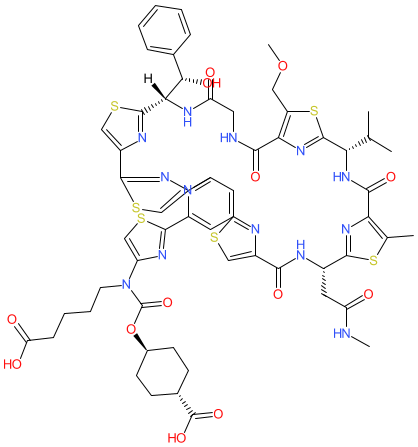
Comment: LFF571 is a macrocyclic thiopetide with activity against Gram-positive bacteria and derived from the naturally occurring antibacterial GE2270 A [2]. Functionally, it inhibits bacterial protein synthesis by targeting elongation factor Tu (EF-Tu) [3]. Note that the structure shown here matches the CAS-assigned structure. The PubChem link, provided in the table below, is to their standardized chemical structure (CID 42638236), although this is not an exact structural match.
2D Structure
Click here for help
Click here for structure editor
SMILES / InChI / InChIKey
Click here for help
Canonical SMILES CC(C)[C@H]1C2=NC(=C(COC)S2)C(=O)NCC(=O)N[C@@]([H])([C@H](C3=CC=CC=C3)O)C4=NC(=CS4)C5=NC(=CS5)C6=NC(=CC=C6C7=NC(=CS7)C(=O)N[C@@H](CC(=O)NC)C8=NC(=C(C)S8)C(=O)N1)C9=NC(=CS9)N(CCCCC(=O)O)C(=O)O[C@H]%10CC[C@@H](CC%10)C(=O)O
Isomeric SMILES O=C1C=2N=C(C=3C(C=4N=C(SC4)C=5N=C(SC5)[C@]([C@@H](O)C6=CC=CC=C6)(NC(=O)CNC(=O)C7=C(COC)SC([C@H](C(C)C)NC(=O)C=8N=C([C@H](CC(NC)=O)N1)SC8C)=N7)[H])=NC(=CC3)C9=NC(N(C(O[C@@H]%10CC[C@@H](C(O)=O)CC%10)=O)CCCCC(O)=O)=CS9)SC2
InChI InChI=1S/C60H63N13O13S6/c1-28(2)44-58-72-47(39(92-58)23-85-5)51(80)62-22-42(75)69-48(49(78)30-11-7-6-8-12-30)57-67-38(26-89-57)55-65-36(24-88-55)46-33(53-66-37(25-87-53)50(79)64-35(21-41(74)61-4)56-71-45(29(3)91-56)52(81)70-44)18-19-34(63-46)54-68-40(27-90-54)73(20-10-9-13-43(76)77)60(84)86-32-16-14-31(15-17-32)59(82)83/h6-8,11-12,18-19,24-28,31-32,35,44,48-49,78H,9-10,13-17,20-23H2,1-5H3,(H,61,74)(H,62,80)(H,64,79)(H,69,75)(H,70,81)(H,76,77)(H,82,83)/t31-,32-,35-,44-,48-,49-/m0/s1
InChI Key GNLYKLDXQZHYTR-LMOGNUDZSA-N

Generated using the Chemistry Development Kit (CDK) (Willighagen EL et al. Journal of Cheminformatics vol. 9:33. 2017, doi:10.1186/s13321-017-0220-4; https://cdk.github.io/)

Bioactivity Comments
LFF571 demonstrates activity against Gram-positive bacteria, including Clostridium difficile. The minimal inhibitory concentration (MIC) for antibacterial activity against C. difficile is 30 nM in vitro [2].