GtoPdb is requesting financial support from commercial users. Please see our sustainability page for more information.

CP-25   Click here for help

GtoPdb Ligand ID: 14284

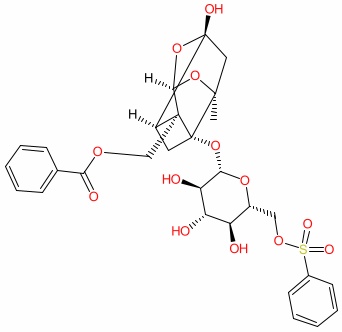
Synonyms: Paeoniflorin-6′-O-benzene sulfonate
Immunopharmacology Ligand
Compound class: Synthetic organic
Comment: CP-25 is a synthetic derivative of the plant-derived natural product paeoniflorin (from Paeonia lactiflora Pall). It has activity as a G protein-coupled receptor kinase 2 (GRK2) inhibitor, with downstream inhibitory effects on the JAK1/STAT3 signalling pathway.
2D Structure
Click here for help
Click here for structure editor
Physico-chemical Properties
Click here for help
Hydrogen bond acceptors 13
Hydrogen bond donors 4
Rotatable bonds 10
Topological polar surface area 195.89
Molecular weight 620.62
XLogP -0.42
No. Lipinski's rules broken 2

Generated using the Chemistry Development Kit (CDK) (Willighagen EL et al. Journal of Cheminformatics vol. 9:33. 2017, doi:10.1186/s13321-017-0220-4; https://cdk.github.io/)

SMILES / InChI / InChIKey
Click here for help
Canonical SMILES C[C@]12C[C@@]3([C@]4([H])C[C@]1([C@]4(COC(=O)C5=CC=CC=C5)[C@]([H])(O2)O3)O[C@H]6[C@@H]([C@H]([C@@H]([C@@H](COS(=O)(=O)C7=CC=CC=C7)O6)O)O)O)O
Isomeric SMILES O=C(C1=CC=CC=C1)OC[C@@]23[C@]4([C@]5(O[C@]2([H])O[C@@]([C@]3([H])C4)(C5)O)C)O[C@@H]6O[C@@H]([C@H]([C@@H]([C@H]6O)O)O)COS(=O)(C7=CC=CC=C7)=O
InChI InChI=1S/C29H32O13S/c1-26-14-28(34)19-12-29(26,27(19,25(41-26)42-28)15-37-23(33)16-8-4-2-5-9-16)40-24-22(32)21(31)20(30)18(39-24)13-38-43(35,36)17-10-6-3-7-11-17/h2-11,18-22,24-25,30-32,34H,12-15H2,1H3/t18-,19-,20-,21+,22-,24+,25-,26+,27+,28-,29+/m1/s1
InChI Key GWADTSPXFRXHLU-DMXKJYKPSA-N

Generated using the Chemistry Development Kit (CDK) (Willighagen EL et al. Journal of Cheminformatics vol. 9:33. 2017, doi:10.1186/s13321-017-0220-4; https://cdk.github.io/)

Download 2D Structure Click here for help
Canonical SMILES Download
Isomeric SMILES Download
InChI standard identifier Download
InChI standard key Download

Molecular structure representations generated using Open Babel