GtoPdb is requesting financial support from commercial users. Please see our sustainability page for more information.


Compound class:
Synthetic organic
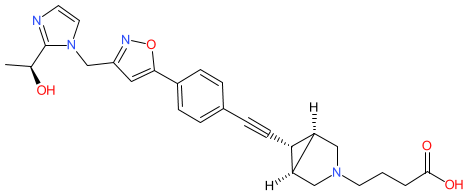
Comment: TP0586532 is a non-hydroxamate inhibitor of bacterial UDP-3-O-acyl-N-acetylglucosamine deacetylase (LpxC) [6]. LpxC is an attractive target for the development of antibacterial agents against Gram-negative bacterial pathogens, although safety and activity issues have so far precluded approval for clinical use of these drugs [1,3]. LpxC inhibitors that do not contain a hydroxamate moiety, such as TP0586532, are predicted to have a reduced risk of cardiovascular toxicity.
Note that the structure shown here matches the CAS-assigned structure. The PubChem link, provided in the table below, is to their standardized chemical structure (CID 155294517), although this is not an exact structural match. |
|
|||||||||||||||||||||||||||||||||||
| References |
|
1. Erwin AL. (2016)
Antibacterial Drug Discovery Targeting the Lipopolysaccharide Biosynthetic Enzyme LpxC. Cold Spring Harb Perspect Med, 6 (7). [PMID:27235477] |
|
2. Fujita K, Takata I, Yoshida I, Okumura H, Otake K, Takashima H, Sugiyama H. (2022)
TP0586532, a non-hydroxamate LpxC inhibitor, has in vitro and in vivo antibacterial activities against Enterobacteriaceae. J Antibiot (Tokyo), 75 (2): 98-107. [PMID:34837061] |
|
3. Niu Z, Lei P, Wang Y, Wang J, Yang J, Zhang J. (2023)
Small molecule LpxC inhibitors against gram-negative bacteria: Advances and future perspectives. Eur J Med Chem, 253: 115326. [PMID:37023679] |
|
4. Raetz CR. (1993)
Bacterial endotoxins: extraordinary lipids that activate eucaryotic signal transduction. J Bacteriol, 175 (18): 5745-53. [PMID:8376321] |
|
5. Raetz CR, Guan Z, Ingram BO, Six DA, Song F, Wang X, Zhao J. (2009)
Discovery of new biosynthetic pathways: the lipid A story. J Lipid Res, 50 Suppl (Suppl): S103-8. [PMID:18974037] |
|
6. Ushiyama F, Takashima H, Matsuda Y, Ogata Y, Sasamoto N, Kurimoto-Tsuruta R, Ueki K, Tanaka-Yamamoto N, Endo M, Mima M et al.. (2021)
Lead optimization of 2-hydroxymethyl imidazoles as non-hydroxamate LpxC inhibitors: Discovery of TP0586532. Bioorg Med Chem, 30: 115964. [PMID:33385955] |