GtoPdb is requesting financial support from commercial users. Please see our sustainability page for more information.

|
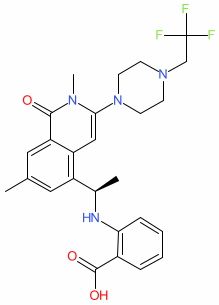
Synonyms: example 8 [WO2024054469A1]
Compound class:
Synthetic organic
Comment: The chemical structure for this compound was obtained from WHO INN proposed list 134 (Feb 2026), in which it is described as a phosphatidylinositol 3-kinase (PI3K) inhibitor with antineoplastic potential. The structure is claimed in patent WO2024054469A1 (OnKure Inc) as example 8 [1]. OnKure's most advance PI3K inhibitor is OKI-219 which is selective for the tumour-driving, PI3K/AKT/mTOR pathway activating mutant PI3KαH1047R [2]. Selectivity for the mutated PI3Kα is proposed to reduce the risk of side-effects arising from on-target inhibition of wild type PI3Kα (such as hyperglycemia, rash, and diarrhea). OKI-219 is orally bioavailable and can cross the blood-brain barrier.

Ligand Activity Visualisation ChartsThese are box plot that provide a unique visualisation, summarising all the activity data for a ligand taken from ChEMBL and GtoPdb across multiple targets and species. Click on a plot to see the median, interquartile range, low and high data points. A value of zero indicates that no data are available. A separate chart is created for each target, and where possible the algorithm tries to merge ChEMBL and GtoPdb targets by matching them on name and UniProt accession, for each available species. However, please note that inconsistency in naming of targets may lead to data for the same target being reported across multiple charts. ✖ |
|
|||||||||||||||||||||||||||||||||||
| Bioactivity Comments |
| Zinilisib (example 8) selectively inhibits proliferation of cancer cells harbouring the PI3KαH1047R mutant [1]; the EC50 is 1-100 nM in T47D cells with the mutated PI3Kα and 2-15 μM in SKBR3 cells with wild type kinase. |
| Selectivity at enzymes | ||||||||||||||||||||||||||||||||||
| Key to terms and symbols | Click column headers to sort | |||||||||||||||||||||||||||||||||
|
||||||||||||||||||||||||||||||||||