GtoPdb is requesting financial support from commercial users. Please see our sustainability page for more information.

|
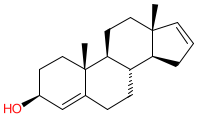
Synonyms: 4-androstadienol | [3β]-androsta-4,16-dien-3-ol | aloradine | PH-94B | PH94B
Compound class:
Synthetic organic
Comment: Fasedienol (PH94B; VistaGen Therapeutics, formerly Pherin Pharmaceuticals) is a pherine, or vomeropherin [4]. Pherines are synthetic neuroactive steroids that are intended to acts as human pheromones via interactions with receptors on nasal chemosensory neurons within the vomeronasal organ (VNO). They are proposed to alter central nervous system activity (e.g., within the limbic amygdala and hypothalamus) through the olfactory system, and without crossing the blood-brain barrier, in turn inducing physiological, pharmacological and behavioural changes. Note that whilst intranasal administration of fasedienol in human subjects is reported to elicit biological and physiological responses [2-3], the functional capacity of vomeronasal receptors and the VNO in humans is open to debate [1,5-7].
|
|
|||||||||||||||||||||||||||||||||||
| References |
|
1. Giorgi D, Friedman C, Trask BJ, Rouquier S. (2000)
Characterization of nonfunctional V1R-like pheromone receptor sequences in human. Genome Res, 10 (12): 1979-85. [PMID:11116092] |
|
2. Liebowitz MR, Hanover R, Draine A, Lemming R, Careri J, Monti L. (2016)
Effect of as-needed use of intranasal PH94B on social and performance anxiety in individuals with social anxiety disorder. Depress Anxiety, 33 (12): 1081-1089. [PMID:27561175] |
|
3. Monti L, Hanover R, Salmán E, Baker RA, Lappalainen J, Smith M. (2024)
Effect of fasedienol (PH94B) pherine nasal spray and steroidal hormones on electrogram responses and autonomic nervous system activity in healthy adult volunteers. Hum Psychopharmacol, 39 (2): e2892. [PMID:38193849] |
|
4. Monti-Bloch L. (2013)
Acute Treatment of Social Phobia. Patent number: US20130172305A1. Assignee: Pherin Pharmaceuticals Inc. Priority date: 13/08/2012. Publication date: 04/07/2013. |
|
5. Monti-Bloch L, Jennings-White C, Dolberg DS, Berliner DL. (1994)
The human vomeronasal system. Psychoneuroendocrinology, 19 (5-7): 673-86. [PMID:7938363] |
|
6. Rodriguez I, Greer CA, Mok MY, Mombaerts P. (2000)
A putative pheromone receptor gene expressed in human olfactory mucosa. Nat Genet, 26 (1): 18-9. [PMID:10973240] |
|
7. Savic I, Hedén-Blomqvist E, Berglund H. (2009)
Pheromone signal transduction in humans: what can be learned from olfactory loss. Hum Brain Mapp, 30 (9): 3057-65. [PMID:19235878] |