GtoPdb is requesting financial support from commercial users. Please see our sustainability page for more information.

|
Synonyms: Glucophage® | LA-6023


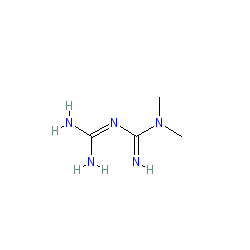
metformin is an approved drug (FDA (1995))
Compound class:
Synthetic organic
Comment: Metformin is the only FDA-approved biguanide class drug. It is formulated as metformin hydrochloride for clinical use. Metformin is often given in fixed-dose combinations with other antihyperglycemic agents.
Repurposing: Cancer cells undergo a metabolic switch to aerobic glycolysis, and become reliant on this metabolic pathway for energy (the Warburg effect). Inhibition of the glycolytic pathway is therefore considered as a tractable therapeutic target in oncology. As metformin is an inhibitor of glycolysis it is being examined for anti-cancer effects in a number of malignancies. Similarly, it is being examined for anti-inflammatory potential since activated immune cells also undergo a metabolic switch to aerobic glycolysis. If found to be effective, this could ultimately lead to metformin being repurposed for indications other than type 2 diabetes. 
View more information in the IUPHAR Pharmacology Education Project: metformin |
|
|||||||||||||||||||||||||||||||||||
| References |
|
1. DeFronzo RA, Barzilai N, Simonson DC. (1991)
Mechanism of metformin action in obese and lean noninsulin-dependent diabetic subjects. J Clin Endocrinol Metab, 73 (6): 1294-301. [PMID:1955512] |
|
2. Hundal RS, Krssak M, Dufour S, Laurent D, Lebon V, Chandramouli V, Inzucchi SE, Schumann WC, Petersen KF, Landau BR et al.. (2000)
Mechanism by which metformin reduces glucose production in type 2 diabetes. Diabetes, 49 (12): 2063-9. [PMID:11118008] |
|
3. Koepsell H. (2013)
The SLC22 family with transporters of organic cations, anions and zwitterions. Mol Aspects Med, 34 (2-3): 413-35. [PMID:23506881] |
|
4. LaMoia TE, Shulman GI. (2021)
Cellular and Molecular Mechanisms of Metformin Action. Endocr Rev, 42 (1): 77-96. [PMID:32897388] |
|
5. Lee CF, Lo YC, Cheng CH, Furtmüller GJ, Oh B, Andrade-Oliveira V, Thomas AG, Bowman CE, Slusher BS, Wolfgang MJ et al.. (2015)
Preventing Allograft Rejection by Targeting Immune Metabolism. Cell Rep, 13 (4): 760-770. [PMID:26489460] |
|
6. Masuda S, Terada T, Yonezawa A, Tanihara Y, Kishimoto K, Katsura T, Ogawa O, Inui K. (2006)
Identification and functional characterization of a new human kidney-specific H+/organic cation antiporter, kidney-specific multidrug and toxin extrusion 2. J Am Soc Nephrol, 17 (8): 2127-35. [PMID:16807400] |
|
7. Schuiveling M, Vazirpanah N, Radstake TRDJ, Zimmermann M, Broen JCA. (2018)
Metformin, A New Era for an Old Drug in the Treatment of Immune Mediated Disease?. Curr Drug Targets, 19 (8): 945-959. [PMID:28606032] |
|
8. Sebo ZL, Chakrabarty RP, Grant RA, D'Alessandro KB, Koss AR, Blum JLE, Davidson SM, Reczek CR, Chandel NS. (2026)
Metformin inhibits mitochondrial complex I in intestinal epithelium to promote glycaemic control. Nat Metab, [Epub ahead of print]. [PMID:42103929] |
|
9. Shu Y, Sheardown SA, Brown C, Owen RP, Zhang S, Castro RA, Ianculescu AG, Yue L, Lo JC, Burchard EG et al.. (2007)
Effect of genetic variation in the organic cation transporter 1 (OCT1) on metformin action. J Clin Invest, 117 (5): 1422-31. [PMID:17476361] |
|
10. Tanihara Y, Masuda S, Sato T, Katsura T, Ogawa O, Inui K. (2007)
Substrate specificity of MATE1 and MATE2-K, human multidrug and toxin extrusions/H(+)-organic cation antiporters. Biochem Pharmacol, 74 (2): 359-71. [PMID:17509534] |
|
11. Zhou M, Xia L, Wang J. (2007)
Metformin transport by a newly cloned proton-stimulated organic cation transporter (plasma membrane monoamine transporter) expressed in human intestine. Drug Metab Dispos, 35 (10): 1956-62. [PMID:17600084] |