GtoPdb is requesting financial support from commercial users. Please see our sustainability page for more information.

|
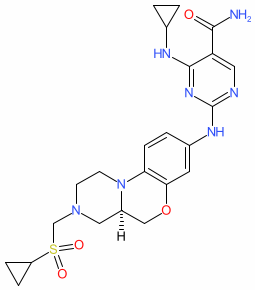
Synonyms: compound I [WO2022188796]

Compound class:
Synthetic organic
Comment: Vexicitinib is one of the INNs included in WHO proposed list 134 (Feb 2026). It is proposed as a Janus kinase inhibitor, for anti-inflammatory/immunosuppressant activities. The compound is claimed in patent WO2022188796A1 [2]. Interrogation of online sources suggests that vexicitinib is likely the INN for clinical candidate SYHX1901, which is an orally bioavailable dual JAK-Syk inhibitor [1].

Ligand Activity Visualisation ChartsThese are box plot that provide a unique visualisation, summarising all the activity data for a ligand taken from ChEMBL and GtoPdb across multiple targets and species. Click on a plot to see the median, interquartile range, low and high data points. A value of zero indicates that no data are available. A separate chart is created for each target, and where possible the algorithm tries to merge ChEMBL and GtoPdb targets by matching them on name and UniProt accession, for each available species. However, please note that inconsistency in naming of targets may lead to data for the same target being reported across multiple charts. ✖ |
|
|||||||||||||||||||||||||||||||||||
| Immunopharmacology Comments |
| Targeting JAKs and Syk simultaneously disrupts the interleukin-23/interleukin-17 axis and B-cell-dependent amplification loops. Preclinical efficacy has been demonstrated in rodent psoriasis models, where treatment reduces skin inflammatory pathologies and levels of immune mediators (IL-6 and TNF-α) in the diseased skin. |